2026
EPDM Geomembrane for Canal Lining: A Durable Solution for Water-Scarce Regions
Canals and irrigation channels move water across distances that make even small seepage rates costly. A reservoir loses water it's already stored; a canal loses water on its way to where it's needed every kilometre of unlined channel is a kilometre of ongoing loss, not a one-time risk.
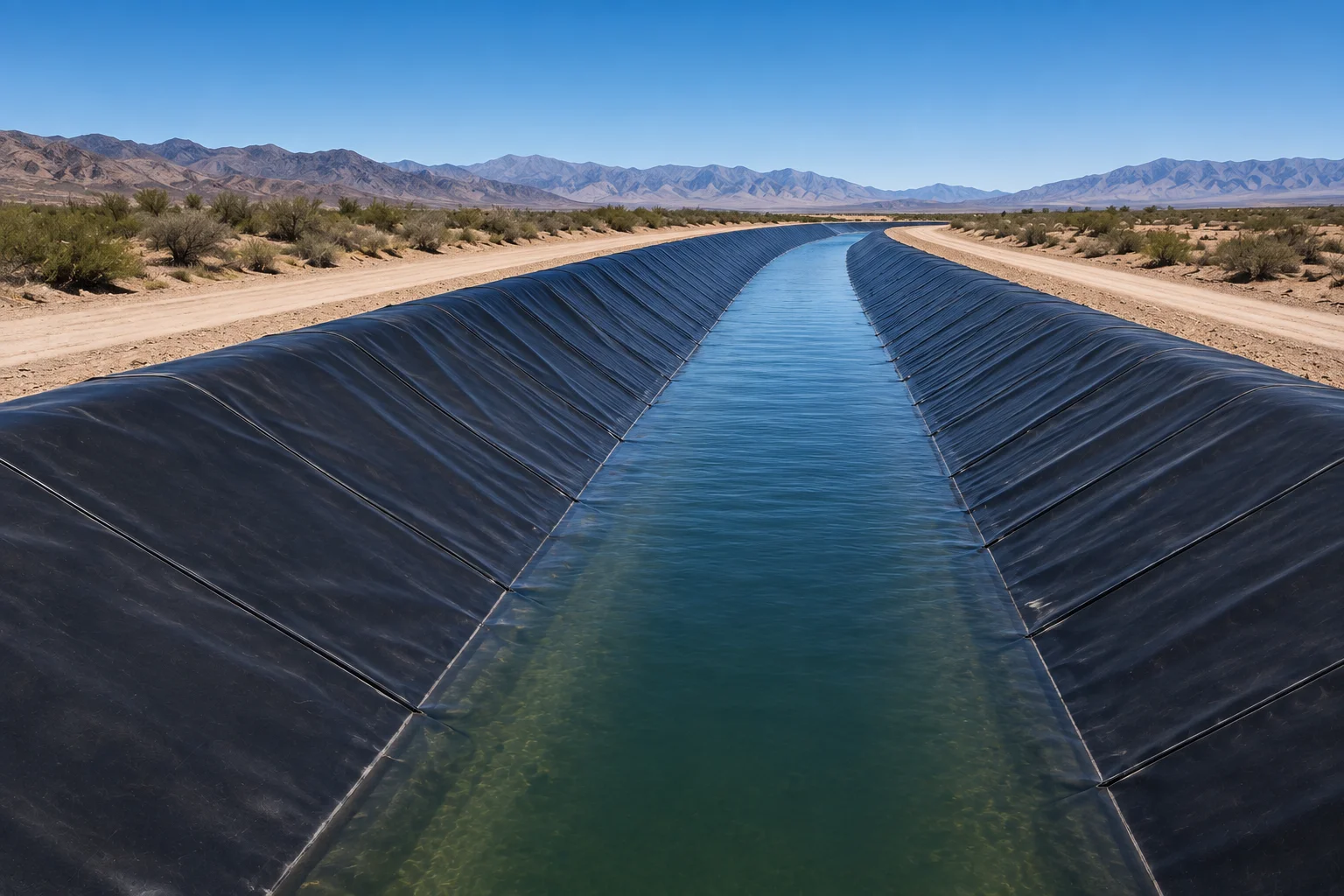
This is why EPDM geomembrane for canal lining has become a specified irrigation canal lining material for irrigation departments, water ministries, and EPC contractors managing linear conveyance infrastructure, particularly across water-scarce regions like the Middle East and Australia.
The Scale of the Problem: Why Canal Seepage Matters
Seepage - the continuous movement of water through the soil beneath a canal bed and banks compounds differently than storage loss. Multiple field studies and engineering reviews have found that unlined irrigation canals can lose a substantial share of the water diverted from the source, depending on soil type, canal age, and construction method, with some documented cases in Australia's earthen irrigation networks among the worst-affected. Even conventional cement-concrete lining, long considered the default fix, remains prone to seepage as joints and slabs crack over years of flow and thermal cycling.
For water-scarce regions, this isn't a marginal inefficiency it directly limits the arable land that can be irrigated, strains groundwater tables through unintended recharge, and forces governments to fund expensive new water sources instead of protecting the supply already in the system. Canal seepage control lining is now treated as a core geomembrane for water conservation strategy in national irrigation planning, not an optional upgrade.
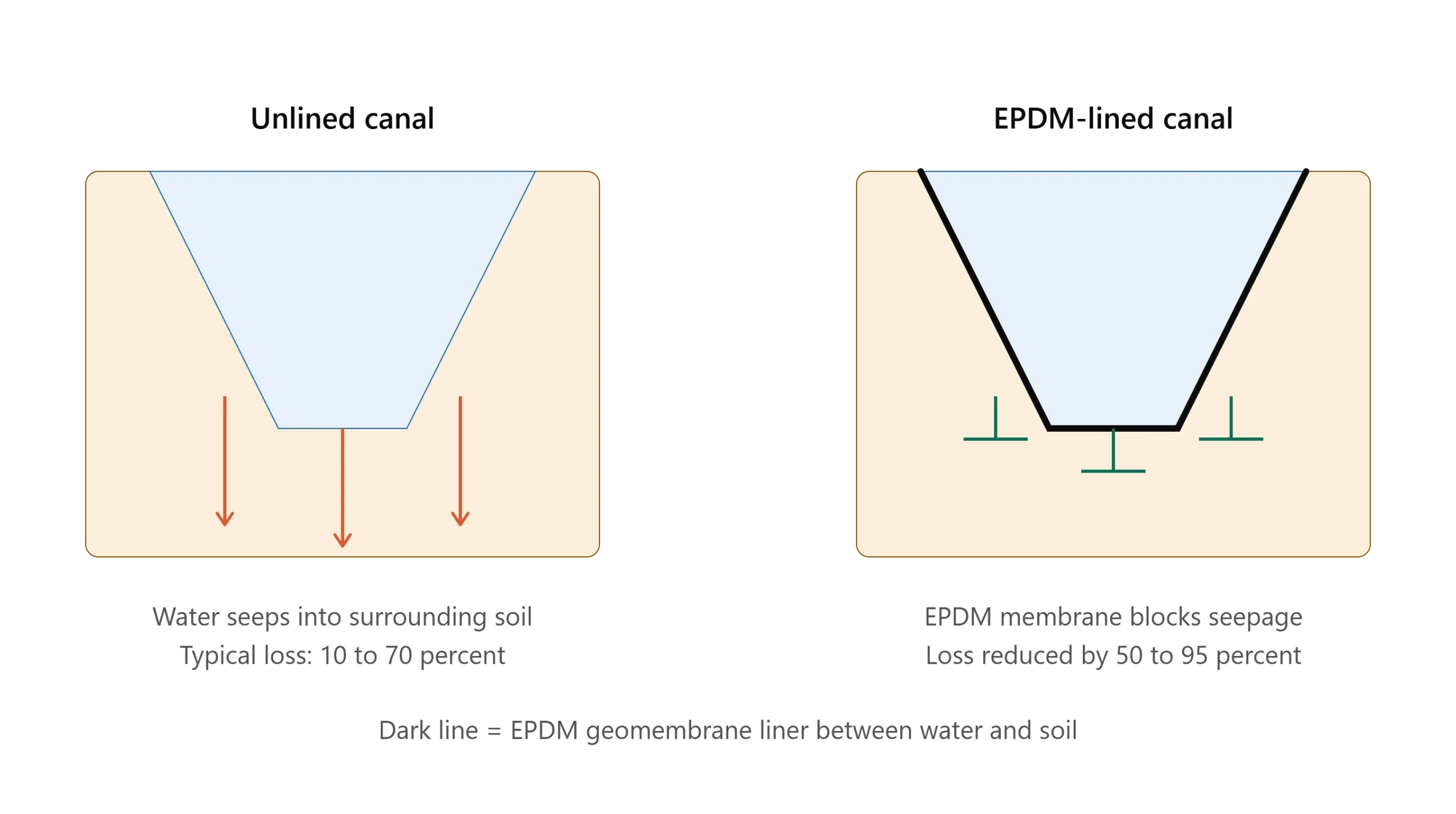
In an unlined canal, water migrates continuously into the surrounding soil along the entire run. An EPDM geomembrane sits between the water and the soil, cutting that loss dramatically over the full length of the channel.
What a Canal Lining Membrane Actually Has to Withstand
Lining a canal is a different engineering problem from lining a static reservoir. The membrane sits under continuous or intermittent flow, variable hydraulic pressure, and on many irrigation networks sediment-laden water moving at meaningful velocity. A few properties matter specifically because of that:
Flexibility across irregular subgrades and long runs:
Canal beds are rarely uniform for kilometres at a stretch. EPDM conforms to uneven soil, gravel, and even cracked concrete substrates without tearing, which matters enormously over a linear installation rather than a bounded pond footprint.
Low-seam installation over distance:
Long canal runs need seams that hold under continuous hydraulic load, not just static water pressure. EPDM's field seams are engineered for exactly this kind of extended, continuous-contact installation.
Resistance to flow-induced abrasion and UV exposure simultaneously:
Open canals are exposed to both moving water and full sun for their entire operational life a combination that degrades many polymer liners faster than either factor alone.
Performance across extreme temperature swings along the route:
A single canal can run through desert heat by day and near-freezing nights, or across a full seasonal range in temperate zones. EPDM stays flexible across that swing without the stiffening or cracking rigid liners are prone to.
Rehabilitation over existing concrete canals:
Many canal-lining projects aren't new-build they're retrofits of aging concrete-lined channels. EPDM can be installed on existing concrete canals, subject to site assessment and suitable preparation, potentially avoiding extensive demolition.
EPDM Canal Lining: Technical Specifications
For canal and channel tenders, technical evaluators need concrete performance numbers to write into specification documents not just qualitative claims.
Here's what governs EPDM's suitability for linear conveyance infrastructure:
| Canal Lining Specification | EPDM Performance |
| Roll width (seams per km of canal) | Up to 15.25 m wide — significantly fewer field seams on long runs |
| Working temperature range | −40°C to +160°C — holds up across desert-to-freeze swings along a canal route |
| Elongation | 300%+ — flexes with ground settlement instead of cracking |
| Installation over cracked concrete canals | Can be installed on existing concrete canals, subject to site assessment and suitable preparation, potentially avoiding extensive demolition |
| Standards compliance | ASTM D-7465, EN 13361 (CE marked) |
| Typical seepage reduction on lined sections | Significantly reduces seepage in lined sections versus unlined sections |
These specifications are what let engineering consultants write EPDM directly into a tender document with confidence wide rolls reduce seam count over long runs, the temperature range covers the full climate swing a canal route experiences, and the elongation rating means the membrane moves with the ground instead of failing at it.
Built for Government and EPC-Scale Procurement
Canal and irrigation-channel projects are rarely small. They're typically multi- kilometre government tenders or EPC contracts with formal technical specification and compliance requirements, a different procurement scale than a single farm dam or municipal storage basin.
Polygomma Industries manufactures EPDM geomembranes at a dedicated 230,000-square-foot facility near Mumbai, India, purpose-built for this kind of large-format, linear-infrastructure supply as an EPDM liner for water-scarce regions and their large-scale conveyance networks.
A few specifics that matter to technical evaluators on canal and irrigation tenders:
- Products are manufactured in accordance with globally accepted ASTM and EN standards
- Membranes carry applicable CE and GOST-R certifications, supporting compliance across European, CIS, and international tender documentation
- Polygomma holds a 20-year patent on its manufacturing technology, granted in 2017, and was recognized as a StartUp by India's Ministry of Commerce & Industry
- Wide, factory-produced rolls reduce the number of field seams needed across long canal runs a direct factor in both installation timeline and long-term leak risk on linear projects
For irrigation authorities, EPC contractors, and engineering consultants scoping canal, channel, or distribution-network lining, these are the credentials that distinguish an infrastructure-grade supplier from a general waterproofing vendor.
Planning a Canal or Channel Lining Project?
Every conveyance project has its own flow characteristics, subgrade conditions, and climate exposure along the route which means the lining specification should be engineered around the canal, not selected off a generic product sheet. If you're an irrigation authority, EPC contractor, or engineering consultant evaluating EPDM geomembrane solutions for a canal, channel, or large-scale water conservation project, Polygomma's technical team can help scope a lining system suited to your site conditions.
(For reservoir, farm dam, or rainwater harvesting storage projects, see our guide on EPDM liners for rainwater harvesting reservoirs.)