2026
Rainwater Harvesting Reservoirs: Why Farms and Municipalities Are Turning to EPDM Liners
Water security is no longer a seasonal worry it's a planning problem. From drought-hit Australian farms rationing bore water to municipalities across Africa and South Asia trying to capture every monsoon drop before it runs off, rainwater harvesting reservoirs have shifted from "nice to have" to core infrastructure. But a reservoir is only as good as what's underneath the water, and that's where most projects quietly succeed or fail: the liner.
More farms and local authorities are now specifying an EPDM liner for rainwater harvesting projects instead of the clay, concrete, or budget plastic sheeting that dominated the last two decades. This article looks at why and how to evaluate whether EPDM is right for your reservoir.
The Growing Case for On-Site Water Storage
Water restrictions in Australia, unreliable municipal supply across parts of Africa, and tightening groundwater regulation in India have all pushed the same conclusion: capture rainwater when it falls, store it on-site, and stop depending entirely on external supply. A rainwater harvesting reservoir liner is the single component that determines whether that stored water stays stored or slowly disappears into the surrounding soil.
The economics are straightforward. A reservoir that loses even 5–10% of its volume annually to seepage effectively shrinks every dry season, right when the water is needed most. For a farm irrigation schedule or a municipal supply buffer, that shortfall isn't an inconvenience, it's a failure of the system's core purpose.
What Is an EPDM Liner for Rainwater Harvesting?
EPDM (ethylene propylene diene monomer) is a synthetic rubber membrane engineered for long-term outdoor exposure. Unlike PVC or standard polyethylene liners, EPDM doesn't rely on plasticizers that leach out and cause brittleness over time. It stays flexible, UV-stable, and highly resistant to several chemicals, which is exactly what a reservoir liner needs to do, since it's rarely inspected or replaced once installed.
Polygomma's EPDM liners, for example, are rated for a service life beyond 25 years in fully exposed conditions, with a working temperature range of -40°C to +160°C and elongation beyond 300%, meaning the membrane can stretch and settle with ground movement instead of cracking. Rolls are factory-vulcanized up to 15.25 meters (50 feet) wide, which matters enormously for large reservoirs: fewer field seams mean fewer potential leak points.
Why Farms Choose EPDM (Farm Dam Liner EPDM)
For farm dams the term used across Australia and much of the Commonwealth for on-farm water storage the priorities are durability with minimal maintenance:
Handles irregular shapes
Farm dams are rarely uniform rectangles. EPDM's flexibility lets it conform to natural contours without the cutting and welding that rigid liners require.
Survives full sun exposure
Many farm dams sit uncovered year-round. EPDM's UV and ozone resistance means the surface doesn't chalk, crack, or thin out the way many plastic liners do after a few dry seasons.
Safe for livestock and aquatic stocking
EPDM is non-toxic and tested for aquatic life safety, so dams that double as stock water or fish-stocked ponds don't introduce chemical risk.
Lower lifetime cost
A liner that lasts 25+ years avoids the re-digging, re-lining, and water-loss costs that come with a 7–10 year plastic liner replacement cycle.
Why Municipalities Choose EPDM (EPDM Geomembrane for Water Storage)
At municipal scale, the calculus shifts toward compliance, installation efficiency, and long-term budget planning:
Standards-driven procurement
Public tenders typically require certified materials. Polygomma's EPDM liners meet EN 13361 (CE marked) and ASTM D-7465, which simplifies specification writing and approval.
Faster large-area installation
Wide, factory-seamed rolls dramatically cut the number of field joints on a large EPDM geomembrane for water storage project, reducing both installation time and the labor cost of seam welding.
Long-term budget predictability
A liner rated for 25+ years removes a recurring capital line item from municipal infrastructure planning, important where reservoir budgets are approved in multi-year cycles.
Dual-use suitability
The same membrane properties that work for irrigation reservoirs extend to stormwater detention and rainwater harvesting basins integrated into urban water management plans.
EPDM vs Other Liner Materials: Best Liner for Water Reservoir Comparison
Choosing the best liner for water reservoir projects usually comes down to comparing EPDM against the three other common options: HDPE, compacted clay/bentonite, and concrete.
| Property | EPDM Rubber | HDPE | Clay / Bentonite | Concrete |
| Flexibility | Excellent; adapts to ground movement and irregular shapes | Moderate; rigid at low temperatures, prone to stress cracking | Low; cracks if it dries out | None; fixed structure |
| UV / weather resistance | Excellent, engineered for permanent exposure | Good, but degrades faster under prolonged UV | N/A (usually covered) | Good, but prone to weathering and spalling |
| Seam risk | Low; factory-seamed panels up to 15.25 m wide | Moderate; many field welds needed on large areas | None, but prone to cracking and burrowing animals | Low, but joints can crack over time |
| Installation speed | Fast; large pre-seamed sheets | Moderate; extensive on-site welding | Slow; requires specific soil and compaction | Very slow; formwork, curing time |
| Upfront cost | Moderate | Lower | Lowest (if suitable soil available) | Highest |
| Best suited for | Farm dams, municipal reservoirs, aquaculture, irrigation storage | Landfills, industrial containment | Small ponds in clay-rich regions with stable water levels | Permanent, high-value infrastructure |
The pattern is consistent: EPDM sits in the sweet spot of durability, adaptability, and installation speed which is exactly why it's become the default choice for reservoirs where downtime, leak risk, and 20+ year performance all matter simultaneously.
Choosing the Right Liner for Large Pond Liner for Agriculture Projects
Sizing and installation planning matter as much as material choice. A few practical considerations for a large pond liner for agriculture project:
Panel width vs reservoir size:
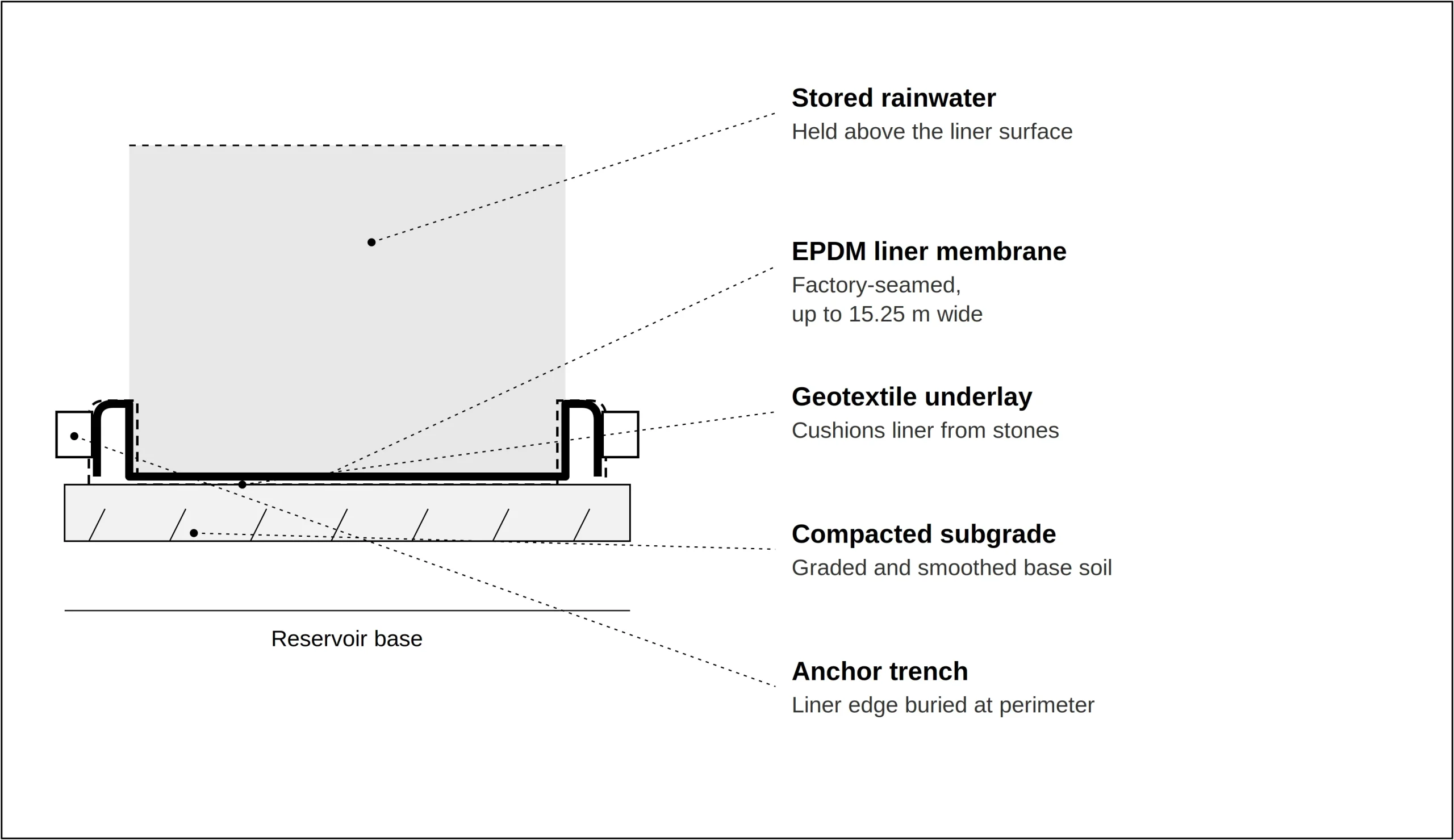
Because EPDM ships in rolls up to 15.25 meters wide with factory-vulcanized seams, many mid-size reservoirs can be covered with drastically fewer field seams than HDPE requires sometimes none.
Subgrade preparation:
The base needs to be graded, compacted, and free of sharp stones. A geotextile underlay is typically added beneath the liner to prevent punctures from ground movement or roots.
Anchor trench detailing:
The liner edge is buried in a perimeter trench to lock it in place and prevent wind uplift or edge creep, especially important on larger exposed reservoirs.
Overflow and inlet penetrations:
Any pipe penetrating the liner needs a proper boot or collar detail this is one of the few points on an EPDM installation genuinely worth getting a specification sheet for.
Frequently Asked Questions
1. Is an EPDM liner safe for a rainwater harvesting reservoir that also stores drinking or irrigation water?
Yes, EPDM used in reservoir applications is non-toxic and chemically stable and is tested to food-contact safety standards under specified conditions. It's suitable for irrigation storage, aquaculture, and general water conservation use, though project-specific testing is recommended for potable applications. For potable-water applications, suitability should be confirmed against the applicable local drinking-water requirements and project specifications.
2. How does EPDM compare to HDPE for a large municipal reservoir?
EPDM offers greater flexibility and fewer field seams thanks to its wide, factory-vulcanized rolls, while HDPE typically requires extensive on-site welding for large areas. Both are viable, but EPDM tends to reduce installation time and long-term seam-failure risk on bigger reservoirs.
3. Can EPDM liners handle seasonal freeze-thaw cycles?
EPDM remains flexible across a wide temperature range (-40°C to +160°C), so it doesn't become brittle in cold conditions the way some plastic liners can.
4. What's the expected lifespan of an EPDM-lined reservoir?
Properly installed EPDM liners are rated for 25+ years in fully exposed conditions, significantly longer than most standard plastic pond liners.
The Bottom Line
Rainwater harvesting reservoirs are only as reliable as their weakest layer and that's almost always the liner, not the earthworks around it. Whether it's a farm dam liner EPDM project in drought-prone Australia or a municipal reservoir built to EN 13361 specification, EPDM's combination of flexibility, UV resistance, and multi-decade lifespan is why it's becoming a proven choice for water storage infrastructure built to last.
If you're specifying a liner for a reservoir project, get in touch with Polygomma's team for technical datasheets, MSDS documentation, and project-specific guidance.