2026
EPDM vs. PVC Pond Liners: What Actually Determines Which One Fails First
Choosing a pond liner sounds simple until you realise that replacing one is far more expensive than installing it correctly in the first place. Many pond owners focus on price or thickness, assuming that the strongest-looking liner will naturally last the longest. Unfortunately, that is not always how it works.
When comparing EPDM vs PVC pond liner, the real question is not which material is cheaper. It is which one is more likely to fail under the conditions your pond will actually experience. Sunlight, ground movement, installation quality, water chemistry, and long-term flexibility all influence performance far more than many buyers realise.
Before making your decision, it helps to understand:
- How different environmental conditions affect each liner over time.
- Why installation practices often determine lifespan more than material thickness.
- What causes early cracking, punctures, and leaks.
- Which material offers better long-term value rather than simply a lower upfront cost.
Understanding these factors will help you invest in a liner that delivers years of dependable performance instead of becoming an expensive replacement project.
Looking Beyond the Material Label
Many discussions about pond liner comparison focus on one simple question: Which material is stronger?
The reality is far more complex. Two ponds built using different materials can have completely different lifespans, even if they were installed in the same year. That is because liner failure is usually caused by a combination of environmental stress, installation quality, maintenance, and material properties.
Think of a pond liner as the protective base that keeps your entire water feature secure and functioning properly. Once it begins to fail, every repair becomes more complicated and costly. Water loss can damage surrounding landscaping, affect aquatic life, and require complete reconstruction if left unnoticed.
This is why experienced contractors rarely judge liners based solely on price. Instead, they evaluate how well each material performs over decades rather than seasons.
What Makes Pond Liners Fail?
Before comparing materials, it is worth understanding the most common reasons pond liners fail.
Constant UV Exposure
Sunlight slowly breaks down many synthetic materials. Areas exposed around pond edges often deteriorate faster than sections submerged underwater.
PVC generally becomes harder as it ages because plasticisers gradually evaporate. Once flexibility decreases, cracks can develop, especially during colder months.
EPDM rubber remains flexible for much longer, allowing it to cope with years of continuous UV exposure without becoming brittle.
Ground Movement
Soil is never completely still.
Seasonal expansion, shrinking clay, nearby tree roots, and minor settlement all place continuous stress on a pond liner.
Materials that cannot stretch with this movement develop stress points over time.
One of EPDM's biggest strengths is its exceptional elasticity. It stretches significantly without permanent damage, making it better suited to natural ground movement.
Installation Damage
Even premium materials can fail quickly if installation is poor.
Common mistakes include:
- Sharp stones left beneath the liner
- Inadequate protective underlay
- Excessive stretching during installation
- Poorly finished seams
- Improper anchoring around pond edges
Many early failures blamed on material quality actually originate from installation errors.
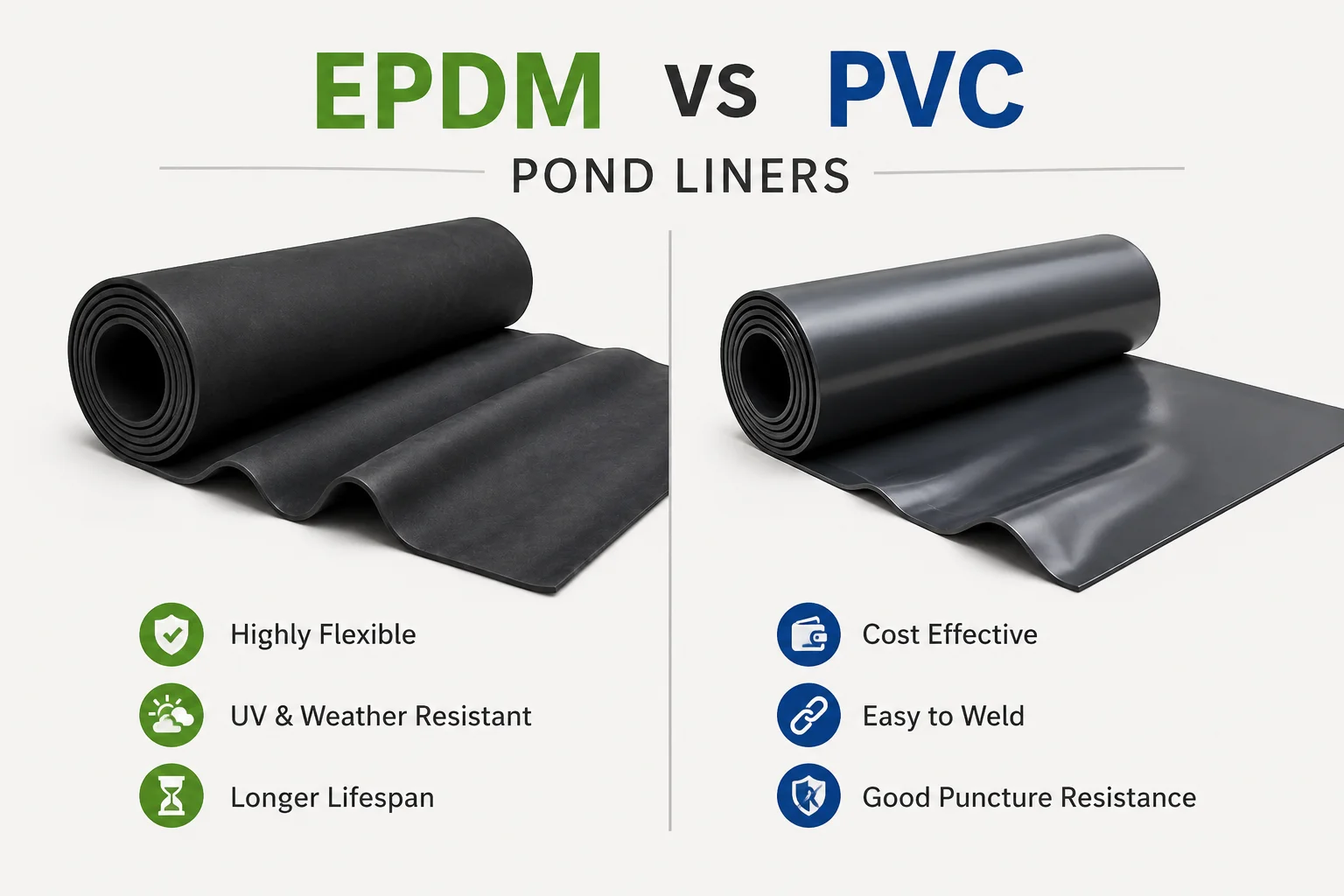
EPDM Pond Liner vs PVC: A Practical Comparison
Both materials have earned their place in the pond industry. The right choice depends on the project's requirements, expected lifespan, and environmental conditions.
| Feature | EPDM | PVC |
| Flexibility | Excellent | Moderate |
| UV Resistance | Very High | Moderate |
| Cold Weather Performance | Excellent | Can become brittle |
| Installation | Heavier but forgiving | Lightweight and easy to handle |
| Expected Lifespan | 30 to 50 years or more | 10 to 20 years depending on conditions |
| Root Resistance | High | Moderate |
| Maintenance | Minimal | Periodic inspection recommended |
| Long-term Value | Excellent | Good for shorter-term projects |
This comparison explains why many landscape architects choose EPDM for larger, permanent ponds while PVC often suits smaller decorative installations where budget is the primary consideration.
Why Flexibility Matters More Than Thickness
Many buyers assume that a thicker pond liner is automatically stronger, but that is not always the case. Over time, thick but rigid materials can develop stress points where they repeatedly bend or adapt to ground movement. A flexible rubber liner, on the other hand, absorbs these stresses more evenly, making it particularly effective for ponds with curves, waterfalls, shelves, and varying depths. This is why discussions around the best pond liner material increasingly focus on long-term flexibility rather than thickness alone.
Environmental Conditions Often Decide the Winner
Choosing between liner materials should always consider where the pond will be installed.
For Sunny Locations
Long periods of UV exposure accelerate ageing. EPDM generally performs better because prolonged sunlight has less impact on its flexibility. PVC can still perform well, but exposed sections require closer monitoring over time.
For Cold Climates
Winter introduces another challenge. Repeated freezing and thawing cause liners to expand and contract. Rubber handles these cycles remarkably well, whereas ageing PVC may gradually become stiffer, increasing the possibility of cracking.
For Wildlife and Natural Ponds
Natural ponds are constantly changing.
- Tree roots grow.
- Rocks shift.
- Wildlife enters and exits.
- Planting expands.
Flexible rubber accommodates these changes more effectively, reducing stress around edges and contours.
Installation Quality Can Add Years to Any Liner
Even the highest-quality liner cannot compensate for poor preparation. Professionals usually focus on several important installation principles.
Prepare the base properly
A smooth, compacted base removes unnecessary pressure points that may later become punctures.
Always use protective underlay
An underlay acts as a cushion between the ground and the liner, protecting it from hidden stones, roots, and debris.
Avoid unnecessary tension
A liner should naturally settle into the pond shape rather than being pulled tightly into position.
Protect exposed edges
The pond perimeter receives the greatest UV exposure and physical wear. Proper edging significantly extends overall service life.
These practices benefit both materials, although flexible EPDM generally tolerates installation imperfections better than PVC.
Understanding the Long-Term Cost Equation
Many purchasing decisions focus on installation budgets alone.
However, the true cost of ownership includes much more than the purchase price.
Consider the following:
- Labour involved in replacing an ageing liner
- Water loss during repairs
- Landscaping restoration
- Fish relocation
- Pump and filtration downtime
- Additional maintenance over time
When viewed over several decades, a material with a higher upfront investment often proves more economical because replacement intervals are significantly longer.
This is one reason discussions around which pond liner lasts longest continue to favour EPDM for permanent installations, despite its higher initial cost.
Rubber Pond Liner vs PVC: Which One Makes More Sense?
There is no universal answer because every pond serves a different purpose.
PVC remains a practical option when:
- Budget is limited.
- The pond is relatively small.
- Installation is temporary.
- Long-term durability is not the primary objective.
EPDM becomes increasingly attractive when:
- The pond is designed as a permanent feature.
- UV exposure is significant.
- Complex pond shapes require greater flexibility.
- Lower lifetime maintenance is important.
- The project is intended to last several decades.
Rather than asking which material is superior, the better question is which one matches the conditions your pond will experience over its lifetime.
Final Thoughts
The debate around pond liner materials compared often centres on technical specifications, but real-world performance tells the more useful story.
A pond liner rarely fails because of one isolated reason. Failure usually results from a combination of environmental exposure, installation quality, maintenance practices, and the material's ability to adapt over time.
PVC continues to serve many successful projects, particularly where budgets are tighter or installations are temporary. However, for permanent ponds expected to perform reliably through changing seasons and decades of outdoor exposure, EPDM consistently demonstrates greater flexibility, weather resistance, and long-term durability.
Ultimately, choosing the right liner is less about today's price and more about preventing tomorrow's replacement.
Build Your Pond for Decades, Not Just Today
Every pond deserves a foundation that can withstand changing weather, ground movement, and years of continuous use. If you are planning a new project or upgrading an existing water feature, choose a liner that delivers dependable long-term performance instead of short-term savings. Explore premium EPDM pond lining solutions from Polygomma and invest in a pond that remains protected for years to come.
Frequently Asked Questions
1. Is EPDM really better than PVC for garden ponds?
When comparing EPDM vs PVC pond liner, the answer depends on the purpose of your pond. EPDM generally performs better for permanent installations because it remains flexible for decades and handles changing weather conditions exceptionally well. PVC can still be an effective solution for smaller decorative ponds or projects with tighter budgets.
- EPDM offers greater resistance to UV exposure and temperature fluctuations.
- PVC is lighter to install but may require earlier replacement.
- Long-term maintenance is usually lower with quality rubber liners.
2. What is the average lifespan of an EPDM pond liner?
If you are researching which pond liner lasts longest, EPDM is widely recognised for its impressive service life. Under proper installation and normal environmental conditions, many EPDM liners continue performing for 30 to 50 years or even longer.
- Correct installation significantly improves durability.
- Protective underlay helps prevent punctures.
- Regular inspections around exposed edges extend overall performance.
3. Which pond liner is easier to install?
The EPDM pond liner vs PVC discussion often includes installation differences. PVC is lighter and easier for one person to handle, while EPDM is heavier but much more forgiving when positioning around irregular pond shapes.
- Flexible rubber adapts easily to curves and shelves.
- PVC requires careful handling to avoid overstretching.
- Proper preparation matters more than installation speed.
4. Does sunlight damage pond liners?
During any pond liner comparison, UV resistance deserves close attention. Continuous sunlight gradually affects every outdoor material, but EPDM generally withstands prolonged exposure far better than PVC, which can lose flexibility as it ages.
- Cover exposed edges wherever possible.
- Inspect visible sections annually.
- Remove sharp debris that may accelerate wear.
5. Which pond liner is best for wildlife ponds?
Choosing the best pond liner material depends on how natural your pond environment will become. Wildlife ponds often experience root growth, shifting soil, and changing water levels, making flexibility a valuable advantage.
- Rubber liners adapt well to natural movement.
- They support complex pond designs with varying depths.
- Long-term durability reduces disturbance to aquatic habitats.